How Leaders Create a Culture of Intrapreneurship
Published: marzo 10, 2026
Leaders create intrapreneurial cultures by fostering psychological safety, granting autonomy within strategic boundaries, and enforcing disciplined accountability. In AgTech, culture determines whether innovation survives.
Beyond Entrepreneurship: The Case for Intrapreneurship
An Intrapreneurship Series Article by Christopher Leonard
Part 3
Introducción
Intrapreneurship does not emerge by accident. It develops in environments where leadership intentionally shapes culture. While strategy defines direction and structure defines accountability, culture determines whether initiative survives long enough to create impact. In science-led sectors such as AgTech, where innovation must balance rigour and responsibility, leadership behaviour becomes decisive.
Leadership as Cultural Architect
Schein (2010) argues that leaders embed culture through what they consistently measure, reward, tolerate, and prioritise. Culture is not declared in mission statements; it is demonstrated in daily reactions. When intelligent risk-taking is penalised, employees internalise caution. When disciplined experimentation is recognised, innovation becomes normalised.
Maxwell (1993) defines leadership as influence. In intrapreneurial environments, influence determines whether individuals feel authorised to think beyond their job descriptions. Leaders who operate purely through positional authority may unintentionally suppress initiative. Leaders who model curiosity, structured challenge, and disciplined follow-through create space for innovation.

Leadership Shaped by Experience
Christopher Leonard’s emphasis on culture emerged not solely from corporate theory, but from lived experience. Early exposure to communal living through YWAM Australia, extended time within different cultural contexts, and later relocation to France highlighted both the power of acceptance and the subtle damage caused by its absence.
Acceptance creates contribution. Exclusion creates compliance. Because he experienced environments where ideas and people were welcomed, he intentionally sought to replicate that atmosphere within organisational settings. Creating space for individuals to share ideas became a leadership priority.
However, fostering acceptance does not mean endorsing every initiative. When team members present numerous ideas simultaneously, Leonard encourages refinement rather than immediate execution. Rather than throwing ideas at the wall to see what sticks, he asks individuals to mature two ideas intentionally before proceeding. In science-driven sectors such as AgTech—where clients depend on rigour and reliability—disciplined focus is not suppression; it is stewardship.
Psychological Safety as Foundational Infrastructure
Edmondson (2018) demonstrates that teams characterised by psychological safety outperform others because members feel safe to voice ideas, question assumptions, and acknowledge uncertainty. Intrapreneurial behaviour inherently involves risk and experimentation; without safety, employees default to compliance.
With psychological safety, they default to contribution. Safety does not eliminate accountability; it ensures accountability does not silence initiative.
Autonomy Within Strategic Boundaries
Amabile (1998) identifies autonomy as a central driver of creativity. Yet autonomy without direction creates fragmentation. Effective leaders therefore establish clear strategic priorities while granting operational freedom within them. This dual structure produces disciplined innovation rather than chaotic experimentation.
Accountability as the Stabilising Force
Bessant and Tidd (2019) emphasise that innovation must connect to measurable outcomes to create value. Schrage (2016) highlights disciplined experimentation as a mechanism for reducing risk while increasing learning speed.
The mature intrapreneurial culture rests on four pillars: psychological safety, strategic clarity, operational autonomy, and performance accountability.
The Four Conditions of Intrapreneurial Culture
Sustained intrapreneurship depends on an integrated system of reinforcing conditions:
- Psychological Safety – Individuals must feel safe to question and propose.
- Strategic Clarity – Innovation must align with organisational priorities.
- Operational Autonomy – Teams require freedom within defined guardrails.
- Performance Accountability – Initiative must translate into measurable outcomes.
Remove one condition and intrapreneurial culture destabilises. Strengthen all four and innovation becomes embedded capability rather than episodic initiative.
The Leadership Tension: Control and Initiative
Leaders in established organisations face a structural tension. Governance demands predictability. Innovation requires uncertainty. Excessive control suffocates initiative; insufficient discipline undermines credibility. The goal is not reckless experimentation, but responsible exploration within strategic guardrails.
Intrapreneurship in Long-Cycle Innovation Environments
Agricultural innovation differs from many technology sectors. Breeding programs extend across multiple seasons. Regulatory approvals demand precision. Data integrity influences yield, sustainability, and food security outcomes.
In such contexts, failure carries consequences beyond financial performance. It affects supply chains, farmer livelihoods, and environmental sustainability. This reality heightens the importance of disciplined intrapreneurship. Innovation in AgTech is not optional. It is stewardship.
Conclusión
Intrapreneurial cultures do not emerge from slogans. They emerge from consistent leadership behaviour. When autonomy, safety, strategic clarity, and disciplined accountability align, innovation becomes embedded capability rather than episodic initiative.
References
Amabile, T. (1998) ‘How to Kill Creativity’, Harvard Business Review.
Bessant, J. and Tidd, J. (2019) Managing Innovation. Chichester: Wiley.
Edmondson, A.C. (2018) The Fearless Organization. Hoboken: Wiley.
Maxwell, J.C. (1993) Developing the Leader Within You. Nashville: Thomas Nelson.
Schein, E. (2010) Organizational Culture and Leadership. San Francisco: Jossey-Bass.
Schrage, M. (2016) The Innovator’s Hypothesis. Cambridge, MA: MIT Press.
Next Time in the Series
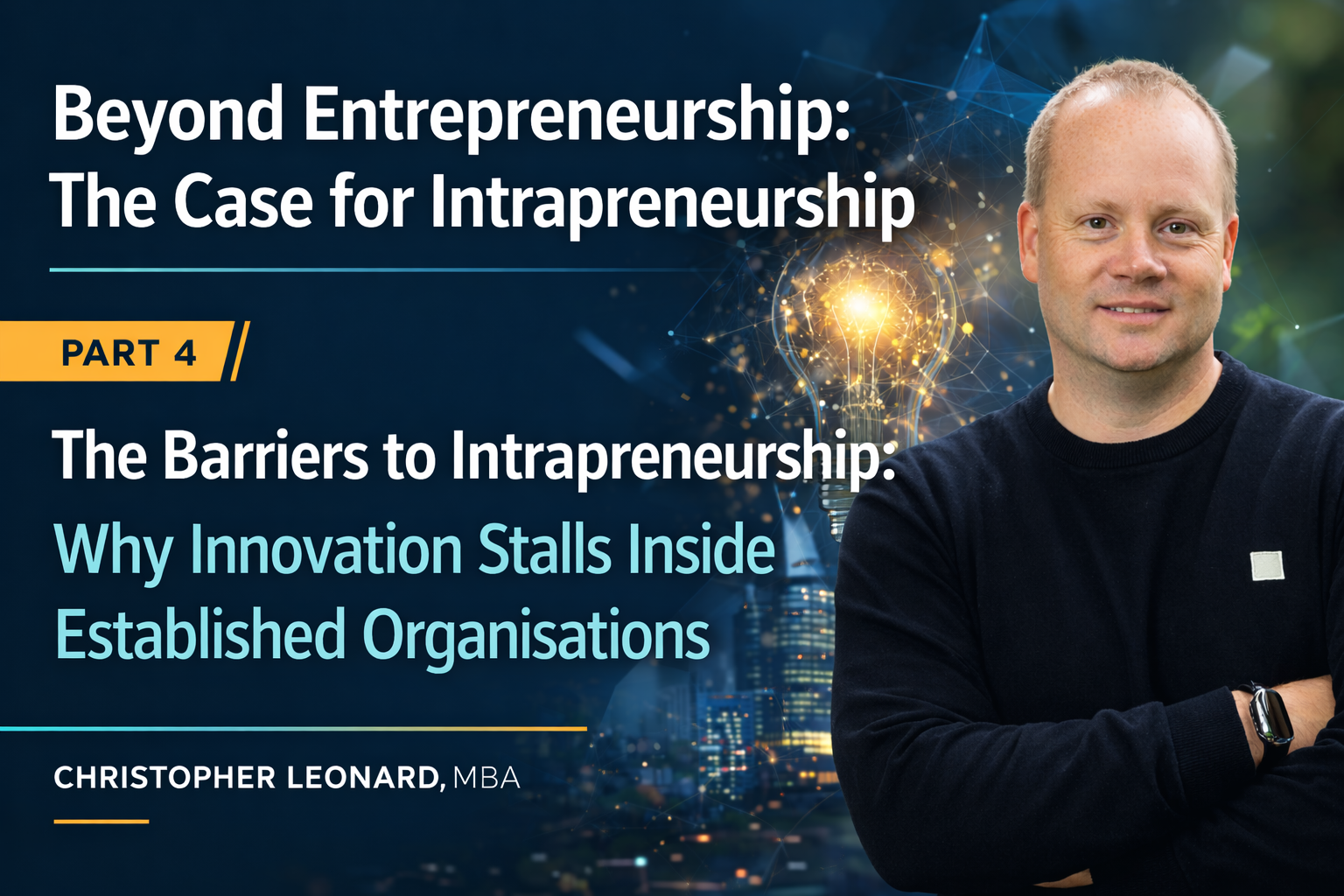
In Part 4, The Barriers to Intrapreneurship, the series examines the structural and cultural obstacles that quietly suppress innovation inside organisations.
About This Series
This article forms part of Beyond Entrepreneurship: The Case for Intrapreneurship, a thought leadership series examining how innovation happens inside established organisations.
Across the series, Christopher Leonard explores leadership, culture, experimentation, technology, motivation, and the movement between founding ventures and transforming them from within.
If innovation matters to your organisation, this conversation matters to you.
Continue the Conversation
Beyond Entrepreneurship explores why intrapreneurship is essential to long-term relevance and sustainable growth. Future articles examine leadership, culture, experimentation, motivation, AI, and the evolving relationship between entrepreneurs and intrapreneurs.
Explore the full series to understand how innovation truly happens — not only at the edge of markets, but at the centre of organisations.
About the Author
Christopher Leonard is President of Agronomix Software Inc., a global leader in plant breeding data analysis tools. With over seventeen years of leadership experience, he is passionate about innovation, entrepreneurship, and the role of technology in strengthening agricultural systems worldwide.